
Minnesota Garage Pros
Garage Door Opener Repair in Minnesota
Deep cold can slow the mechanics inside an opener and stiffen its lubricant, so a unit that ran fine in fall can start acting sluggish once a real Minnesota cold snap sets in.
Opener Repair · Minnesota
Opener Repair for Minnesota homes
An opener in International Falls or along the Iron Range can go weeks at a stretch without the temperature climbing out of single digits, and that kind of sustained cold does more to a drive gear and circuit board than a single hard freeze does farther south. Grease thickens, belts and chains lose flexibility, and a motor working harder on every cycle wears down faster than it would through a milder stretch of a Minnesota winter.
For many Twin Cities homeowners, the bigger risk is condensation rather than raw cold. A sudden swing between a heated attached garage and cold outside air can leave moisture inside the opener's housing, and that moisture reaching the circuit board can cause a fault that looks like a motor problem long before the motor itself is actually at issue.
Minnesota
What's different in Minnesota
- 01
Sustained Cold Wears Differently Than a Single Snap
Weeks of unbroken cold common in northern Minnesota put steadier strain on an opener's grease and gears than the shorter cold snaps that affect the Twin Cities, so symptoms can appear earlier in the season up north.
- 02
Condensation Can Mimic a Motor Problem
A quick swing between a warm attached garage and cold outside air can let moisture reach an opener's circuit board, producing a fault that looks like a motor issue when it isn't.
- 03
Remotes and Keypads Feel the Cold Too
A remote left in a cold vehicle or a keypad mounted outside can develop battery or contact problems faster during a Minnesota winter than one kept at room temperature.
Know the signs
When you need opener repair
Common symptoms
- Opener runs but the door doesn't move, or moves only partway
- Door reverses immediately after touching the floor, or won't close at all
- Remote or wall button works inconsistently or not at all
- Opener makes grinding, clicking, or straining noises during operation
- Light on the opener flashes to indicate an error
What the service covers
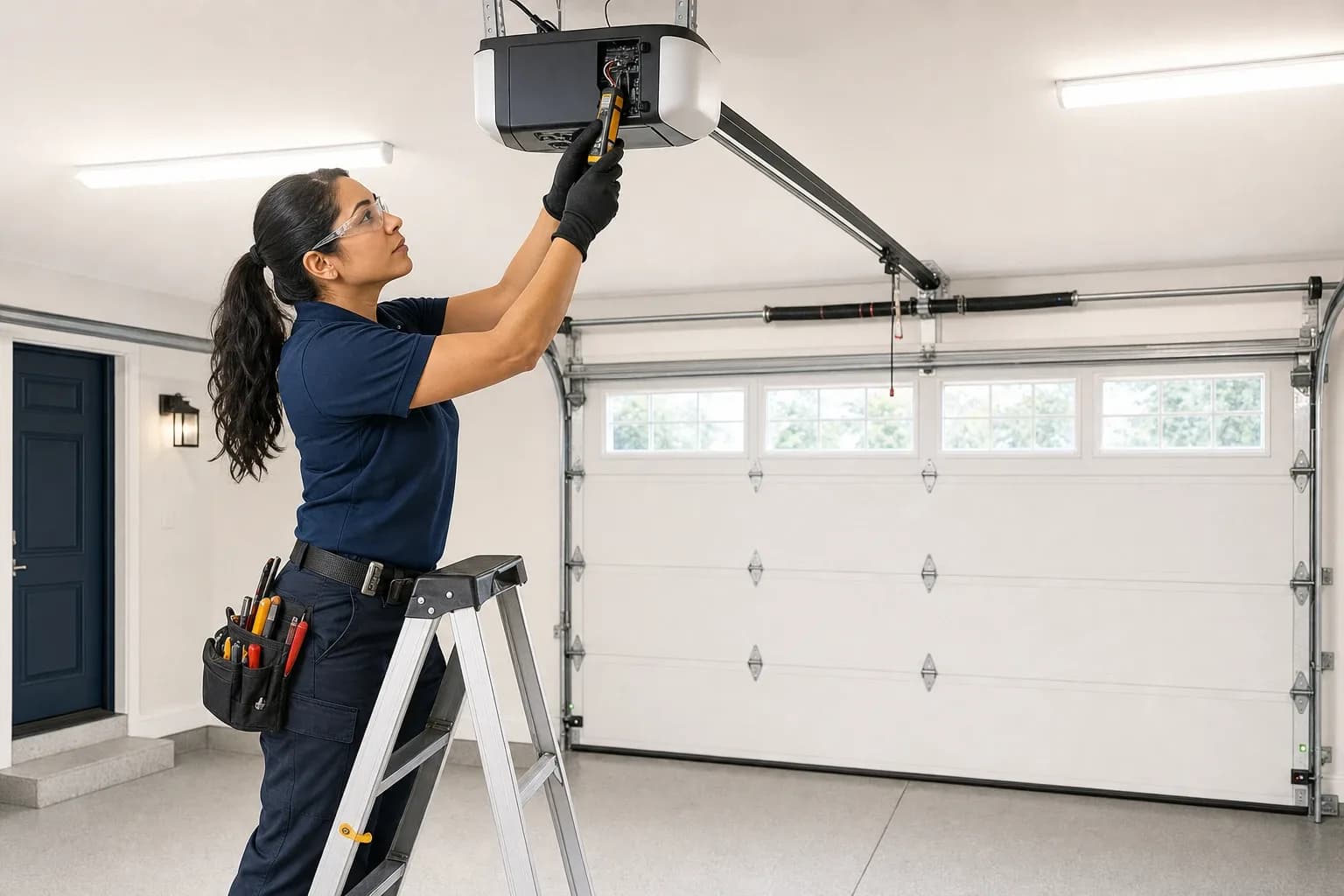
- Diagnosis of the motor, drive system, and logic board
- Testing and adjustment of travel limits and force settings
- Repair or replacement of the drive chain, belt, or screw drive as needed
- Confirmation that the auto-reverse safety feature responds correctly
The process
How the work is done
- 1
Test opener function
The opener is run through several cycles to see exactly where it fails: on start, mid-travel, or when reversing.
- 2
Check the drive and logic board
The chain, belt, or screw drive and the opener's logic board are inspected for wear, damage, or incorrect settings.
- 3
Repair the specific fault
Depending on the cause, this may mean adjusting travel limits and force, replacing a worn drive component, or repairing wiring to a control or sensor.
- 4
Verify the safety reversal
The auto-reverse feature is tested to confirm the door reverses immediately on contact with an obstruction, as required for residential openers.
Cost factors
What affects the price
Prices aren't published because they depend on your door, the parts involved and the access to the work. These are the things that move the cost — ask for the price before any work starts.
- Drive type
- Chain, belt, and screw-drive openers use different parts for repair.
- Which component has failed
- A remote or sensor issue is typically quicker to resolve than a motor or logic-board fault.
- Opener age and part availability
- Older openers may need parts sourced or, if unavailable, a full unit replacement.
- Related door issues
- If a door-side problem, such as an unbalanced door, is straining the opener, that gets addressed too.
Safety first
- Never bypass, disconnect, or block a photo-eye sensor to force a door to close — this removes a required safety feature.
- Disconnect power to the opener before inspecting the motor unit or wiring.
- Test the auto-reverse feature regularly per the opener manufacturer's guidance; the door should reverse on contact with an obstruction.
Safe things to check first
- With the door in view, note at what point in the cycle it stops, reverses, or makes noise.
- Check whether the indicator lights on the two photo-eye sensors near the floor are lit steadily; a blinking or dark light can point to a sensor issue.
- Test the auto-reverse feature per the opener manufacturer's guidance and confirm the door reverses on contact with an obstruction.
Local pages
Opener Repair by city
Answers
Opener Repair questions in Minnesota
Why does my opener act up more in northern Minnesota than in the Twin Cities?
Sustained sub-zero stretches common in areas like the Iron Range put steadier strain on an opener's grease and gears than the shorter cold snaps typical farther south in the state.
Could moisture be the real problem instead of the motor?
It's possible. A sudden swing between a warm attached garage and cold outside air can let condensation reach the circuit board, which can resemble a motor fault without one actually being present.
Related
Related services
Minnesota Garage Pros
Request service
Send the details in two quick steps. This isn't a booking — we contact you to confirm the problem, the timing and the location first.
Sources
- Automatic Residential Garage Door Operators — U.S. Consumer Product Safety Commission (accessed 2026-09-24)
- UL 325 50th Anniversary & Key Safety Issues — UL Solutions (accessed 2026-09-24)