
Pennsylvania Garage Pros
Garage Door Spring Repair in Pennsylvania
Torsion springs work harder through a Pennsylvania winter as cold metal loses some flexibility, which is why spring failures cluster in the coldest months and always call for a trained technician, never a DIY fix.
Spring Repair · Pennsylvania
Spring Repair for Pennsylvania homes
Torsion springs carry the full weight of a garage door under constant tension, and Pennsylvania's cold winters make that tension harder on the metal. As temperatures drop, springs lose some flexibility, and that stiffness is part of why spring failures cluster in the coldest months across the state, from the Lehigh Valley's Pocono-adjacent cold to Erie's harsher snowbelt.
A broken or visibly stretched spring is never something to test or adjust yourself. The tension involved can cause serious injury, so the only safe step for a homeowner is to leave the door closed and call a trained technician.
Pennsylvania
What's different in Pennsylvania
- 01
Cold makes failures more likely, not more predictable
A spring that has been wearing down for months can fail on an ordinary day, but Pennsylvania's freeze-thaw winters add extra stress that often pushes an aging spring toward its breaking point.
- 02
A stuck door usually means a spring, not the opener
If a door won't open and the opener strains or hums without moving it, a broken spring is a common cause, and forcing the opener further can cause additional damage.
Know the signs
When you need spring repair
Common symptoms
- A loud bang from the garage, often followed by the door feeling very heavy
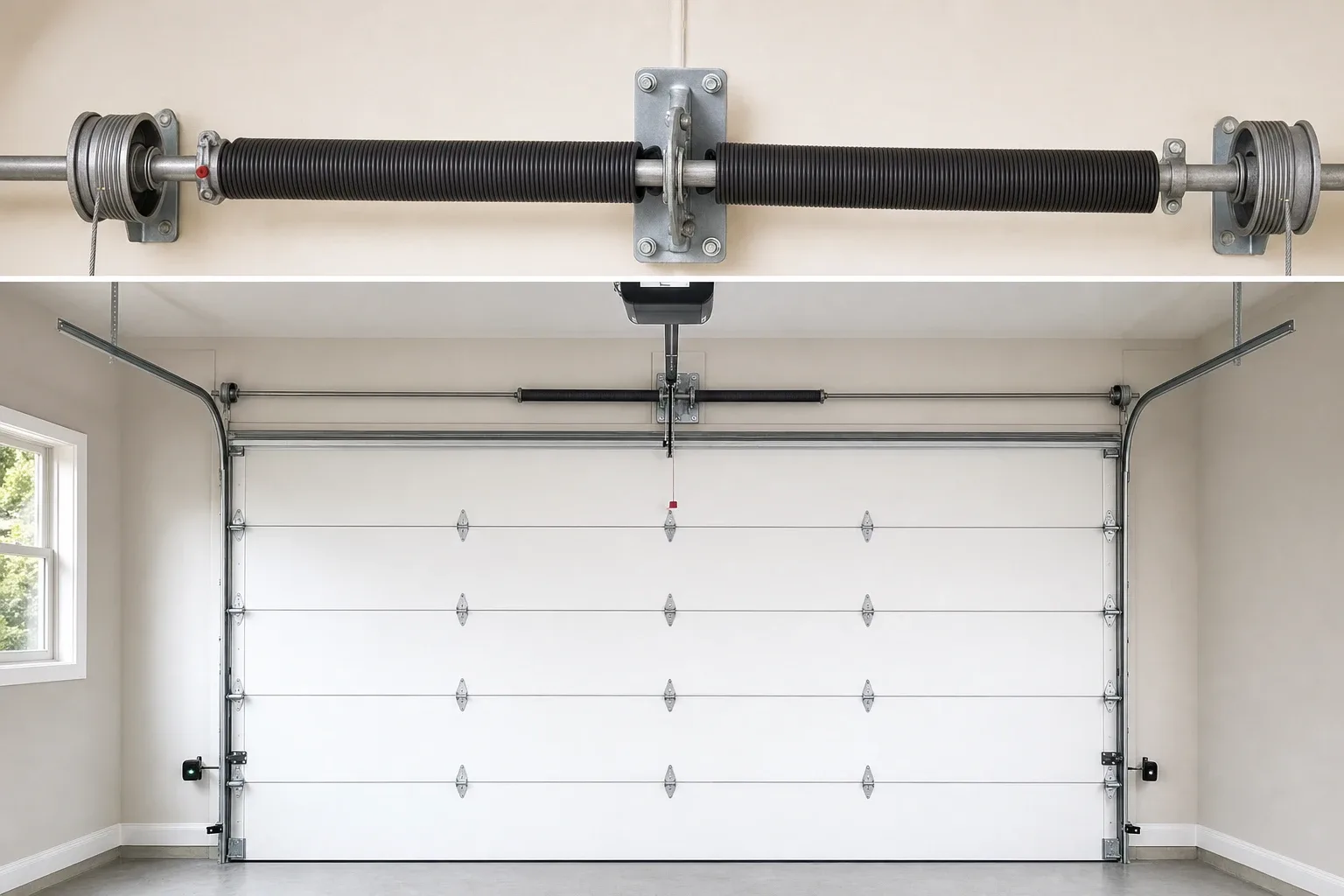
- Visible gap or separation in a torsion spring coil above the door
- Door won't stay open partway, or drops quickly when disconnected from the opener
- Opener strains, struggles, or makes grinding noises trying to lift the door
What the service covers
- Inspection of the spring system, shaft, bearing plate, and cable drums
- Safe release of any remaining tension in a damaged spring before removal
- Replacement or rebalancing of the spring set matched to the door's weight
- Test of door balance and smooth travel through a full cycle
The process
How the work is done
- 1
Confirm the spring is the issue
The spring, shaft, bearing plate, and drums are inspected, since a heavy or uneven door can sometimes point to a different cause.
- 2
Safely relieve stored tension
Any tension remaining in a damaged spring is released using proper winding bars and clamps before the spring is removed.
- 3
Fit and set the new spring
A spring matched to the door's weight and cycle needs is installed and wound to the correct tension on the shaft.
- 4
Balance and test the door
The door is cycled to confirm it lifts evenly, holds position when partly open, and the opener no longer strains.
Cost factors
What affects the price
Prices aren't published because they depend on your door, the parts involved and the access to the work. These are the things that move the cost — ask for the price before any work starts.
- Spring type
- Torsion springs mounted on a shaft above the door and extension springs alongside the upper tracks use different parts and setup.
- Number of springs
- Heavier doors often use two torsion springs rather than one, which affects the parts needed.
- Door weight and cycle life
- A heavier door, or one that opens frequently, needs a spring rated for more cycles.
- Condition of related hardware
- Worn cables, drums, or a bent shaft found during inspection may need attention at the same time.
Safety first
- Never attempt to loosen, wind, cut, or remove a torsion or extension spring yourself — the stored tension can cause serious injury or death.
- Do not disconnect the opener or try to manually lift a door with a broken spring; the door can be significantly heavier than expected.
- Keep children, pets, and vehicles away from a garage with a known spring problem until it has been inspected.
Safe things to check first
- From a safe distance, look at the torsion spring above the door for a visible gap in the coil or a section that looks separated — do not touch it.
- Note whether you heard a loud bang from the garage, which often means a spring has broken, and avoid using the door until it's inspected.
Local pages
Spring Repair by city
Answers
Spring Repair questions in Pennsylvania
Is it safe to replace a garage door spring myself?
No. Torsion and extension springs stay under very high tension, and attempting to replace or adjust one yourself risks serious injury. This is a repair for a trained technician only.
Why do garage door springs seem to fail more in Pennsylvania winters?
A spring under tension already loses some give as metal contracts in the cold, and Pennsylvania's freeze-thaw pattern, especially the Lehigh Valley's Pocono-adjacent stretches and Erie's snowbelt, cycles through more hard-freeze days than a milder state would, which is why failures bunch up in January and February.
Related
Related services
Pennsylvania Garage Pros
Request service
Send the details in two quick steps. This isn't a booking — we contact you to confirm the problem, the timing and the location first.
Sources
- TDS #190 — Factors Affecting Spring Cycle Life — Door & Access Systems Manufacturers Association (DASMA) (accessed 2026-09-24)
- Government and Industry Move To Reduce Garage Door Opener Child-Entrapment Deaths — U.S. Consumer Product Safety Commission (accessed 2026-09-24)