

The short answer
Most doors that stop, reverse, or refuse to close are being stopped by their own safety system, not failing outright. The three most common causes are a blocked or misaligned photo-eye sensor, an obstruction or misalignment in the track, and an opener limit setting that's out of adjustment. Work through the sensors first, since federal safety rules have required them since 1993 and they're the single most common reason a door won't finish its cycle. If the door reverses hard the moment it touches the floor, or won't move at all, stop and get a professional to look at it rather than forcing an adjustment.
Start with the safety sensors
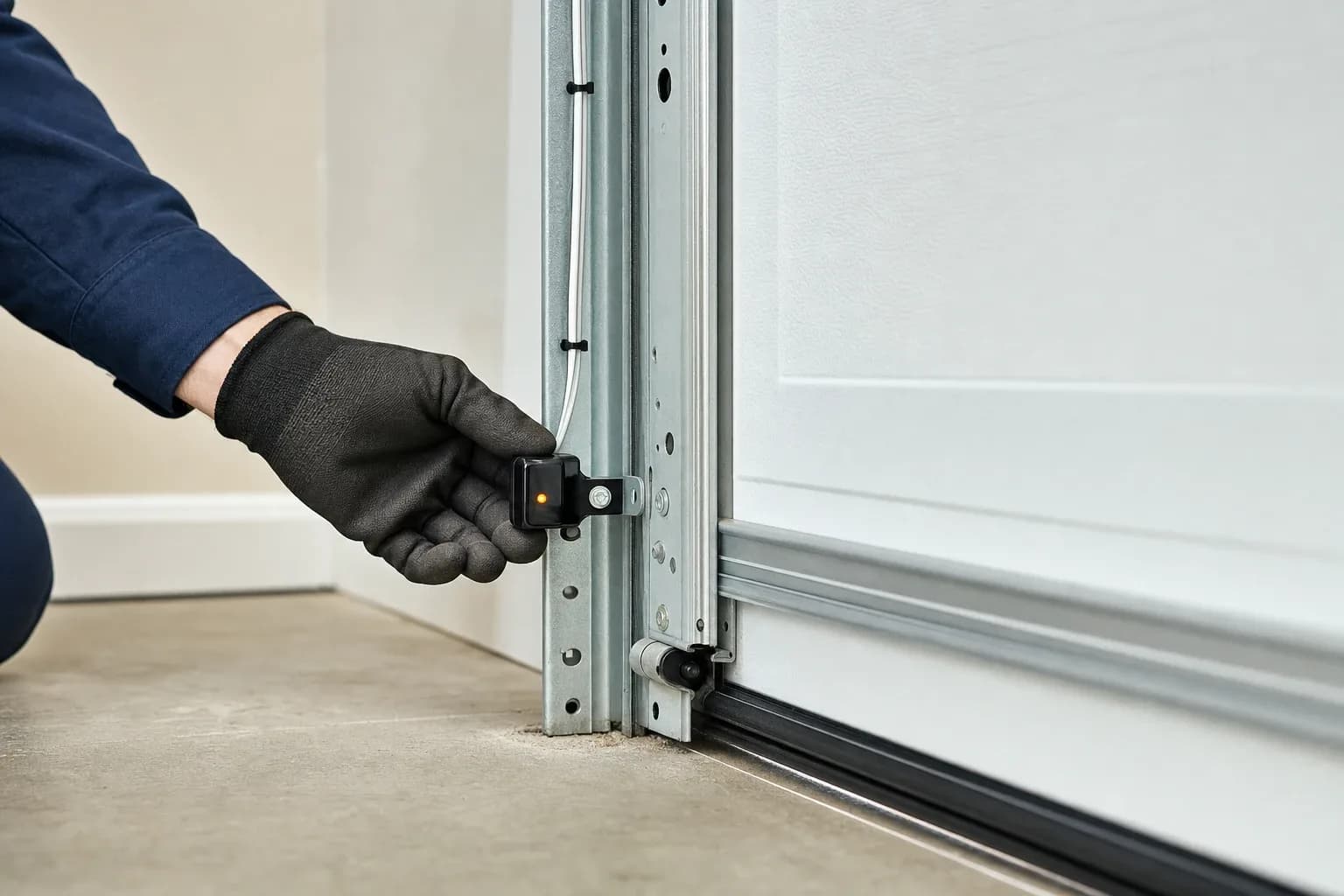
Every residential garage door opener sold in the U.S. since 1993 has to include an external entrapment-protection device, almost always a pair of photo-eye sensors mounted near the floor on each side of the track. If anything breaks that infrared beam while the door is closing, the opener is required to stop and reverse. A sensor that's dirty, knocked out of alignment, or facing direct sunlight can trigger the same reversal even when nothing is actually in the way.
Check both sensor lenses for dust, cobwebs, or condensation, and confirm the small indicator light on each unit is lit steadily rather than flickering. Bumped brackets are common after a car mirror, a broom, or a stored bike nudges one out of line; the two lenses need to be pointed directly at each other for the beam to register.
- Wipe both lenses with a soft, dry cloth
- Sight down the beam path to see if the brackets are aimed at each other
- Check whether direct morning or afternoon sun hits either sensor
- Confirm the sensors sit close to the floor, not several feet up
Look at the track for obstructions or misalignment
Debris, a stray toy, or a buildup of dirt inside the track can be enough to stop a door partway through its travel. A track that's bent or has pulled away from the wall bracket will bind the rollers and produce the same symptom, and it tends to get worse each time the door runs.
With the door open, walk the length of both tracks and look for gaps between the roller and the track wall, visible kinks, or loose mounting brackets. Small debris is safe to clear by hand; a bent track or a bracket pulling loose from the framing is a repair job, not a cleaning job.
Check the opener's close-limit setting
Openers use a limit setting to tell the motor how far down to run before it considers the door fully closed. If that limit is set too high, the door may stop short of the floor and reverse, or refuse to complete its final few inches. Manufacturers publish the exact adjustment steps for their model in the opener's manual, and getting the force and limit settings wrong in the other direction can make the door press too hard against the floor or an obstruction.
Test whether it's the door or the opener
Pull the manual release cord with the door fully closed to disconnect it from the opener, then lift the door by hand. It should move smoothly and evenly with moderate effort. If it feels heavy, drags on one side, or the door doesn't stay put partway open, the problem is in the door's hardware or spring balance, not the opener, and that's a job for a trained technician rather than a limit adjustment.
What not to try yourself
Never disconnect, cover, or tape over a photo-eye sensor to force a door to close past an obstruction; that removes the entrapment protection the sensor is there to provide. Torsion springs, extension springs, lift cables, and the bottom brackets they attach to are under continuous high tension and should only be adjusted or replaced by a trained technician.
Published by USA Garage Pros · Updated 2026-09-24